
Thanks to Flyback for providing expertise on the topic!
The previous article in this series on how Russia could use its nuclear technology to counter the US advantage in satellite constellations looked at the “nice” option: putting a lightweight nuclear reactor on a spacecraft, to power either an electromagnetic jammer, or a directed energy weapon. Jamming is the softest scenario, in that after the jammer is turned off everything goes back to normal. Directed energy attacks are irreversible, satellites are destroyed but without creating much debris and without collateral damage.
But there is a much more hostile option: detonating a nuclear weapon in space. Such an explosion would not only violate the 1967 Outer Space Treaty, at least if the weapon is in orbit since it prohibits the placement of weapons of mass destruction there, but it would also not discriminate between American satellites, Russian ones and those of third parties, including China’s own constellations. And it could even have an impact on the ground. So the collateral damage would be maximal. Even though Putin has denied having such plans, Russia vetoed a UN resolution reaffirming the 1967 ban, prompting the US to confirm it is indeed worried about Russia putting a nuke on a satellite.
Despite the collateral damage, as a final escalation step before using nuclear weapons on the ground, such a weapon could have value. We will look step by step at the physical effects of a high-altitude nuclear explosion, and their impact on satellites:
Direct radiation

First, right after the explosion of the bomb, there is a direct and instant effect, consisting in the neutrons, X-rays and gamma rays produced by the bomb hitting neighbouring satellites. Contrary to explosions within the atmosphere, there is no air to absorb them, so they go further and there is no pressure wave and no large fireball. The effect is purely line of sight and decreases as the square of the distance. The graph above, taken from the US Defense Threat Reduction Agency’s (DTRA) 2010 report on the Collateral Damage to Satellites from an EMP Attack (a recommended read for going more in depth, a lot of this article is based on it), shows that Earth and its atmosphere shield most of Low Earth Orbit from this effect, no matter where the detonation takes place. So while in the case of a single satellite, a well-placed detonation can take it out directly, for a constellation, most of it (around 80% according the the DTRA report) will be protected from the line of sight effects. Still, the gap created by the explosion can be an issue for data backhaul through intersatellite links and will create gaps in coverage.
For higher orbits like the Medium Earth Orbit (MEO) used by GPS satellites and the Geostationary Orbit (GEO), the distances between satellites of a constellation are much greater, and while the shielding from Earth will be minimal, it is very hard to impact several satellites of the constellation at the same time. However, there are many satellites in GEO, including a lot of civilian communication satellites, so detonating a nuke there will likely take out some and thus cause collateral damage.
Electro-Magnetic Pulse
Second, and also almost instantly, the gamma rays hit the upper atmosphere at around 40km high. This ionizes the atoms, and the freed electrons spiral around magnetic field lines, generating a radio wave. Because the gamma rays not yet absorbed by the atmosphere and the emitted wave race towards the ground at the speed of light, a very short but intense pulse is generated in the same direction. The intensity on the ground of this initial pulse can reach 50 kV/m at the peak, and 25 kV/m in a large area. So the effects are similar to a directed energy High-Power Microwave attack, and all unshielded electronics can be affected. A series of longer but weaker pulses follow (more details on the physics here).
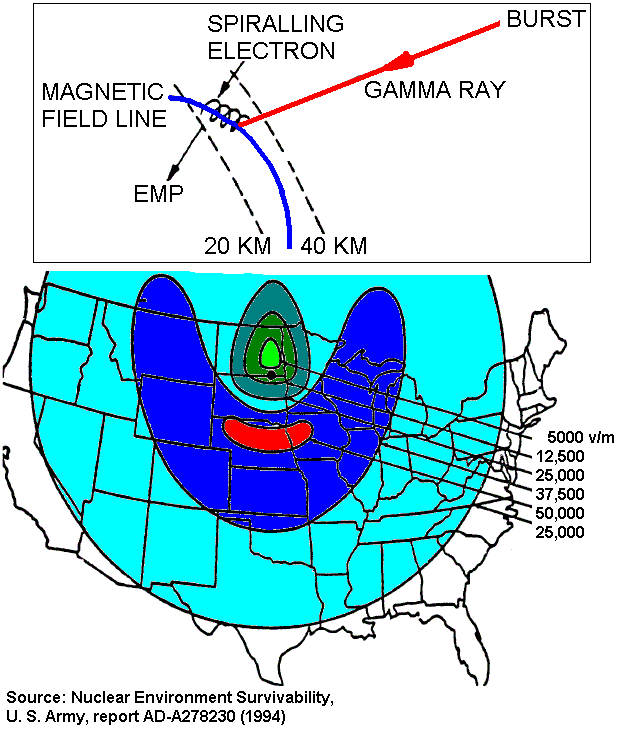
Now the 25 kV/m area is on the ground, and the ground is much closer to the wave-emitting layer of the atmosphere (at 40km high) than LEO satellites would be (at least 400 km). We should expect the EMP field to decrease with distance and thus have a much reduced impact on satellites. However, because the current is generated over a region a few thousand km wide, when considering altitudes small compared to that, we are essentially dealing with an infinite sheet of current, and consequently the intensity should not decrease much with altitude, at least near the center of the pulse. The initial pulse will also go upwards after reflection and scattering by the ground, while the later ones have a component going directly upwards. So it might be possible to take out low-altitude satellites within a wide (let’s say 2000 km diameter) region. At higher altitudes, the inverse square law takes over and at GEO for instance, the pulse will be much attenuated, making it a non-issue, except maybe for radio communication systems pointed at Earth, which will pick up the signal and amplify it (front-door coupling in HPM parlance). Military communication satellites are supposed to be hardened against it though.
The EMP is not persistent, so for best effect the bomb has to be detonated at a location with a maximum density of satellites. Against constellations, this is typically at a latitude corresponding to the inclination of the orbital planes, so at the poles for sun-synchronous constellations. According to the wikipedia article, there is an impact of latitude, and the effect is stronger at high latitudes, so that would also play in favour of polar detonation. Besides, to minimize the impact on the ground (if that is an objective), that is also a good location. And the North Pole is quite close to Russia, facilitating the delivery and reducing warning time.
Against a polar constellation with 10 satellites per plane, assuming a 2000 km diameter area in which the EMP is strong enough to disable the satellite, it would affect on average 0.5 satellite per plane. So it would take out 5% of the constellation, which is not a lot. And that is in a favorable case because all planes cross at the pole. A mid-inclication constellation would be even less impacted, with some of the planes still intact.
Overall, the EMP does not seem to be a very efficient mechanism, multiple shots would be needed to have a meaningful impact. Maybe the Russian are working on a bomb that has an increased gamma-ray yield, so that it could be detonated higher to induce an EMP in a larger area. According to wikipedia, hydrogen bombs (with a fusion stage) are less efficient at producing gamma than atomic bombs (with only a fission stage), because the additional material needed to make fusion work absorbs a lot of them.
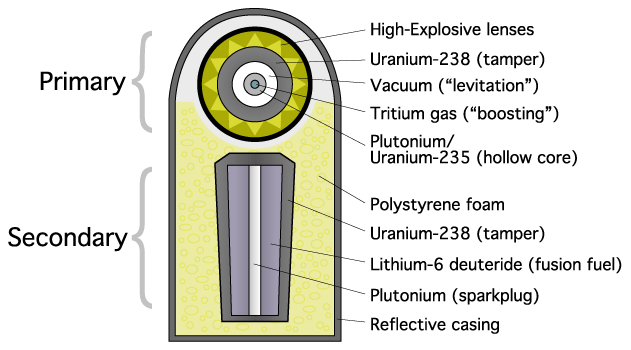
This would favour a single-stage weapon, either pure fission or boosted fission. Conversely, it means it is also possible to reduce this effect by having a lot of shielding around the device, such as an oversized tamper around the fission core, if the goal is to focus on the last effect without collateral damage on the ground due to the EMP:
Pumping the radiation belts
The last and most important effect of the detonation is that it produces high-speed electrons through the decay of the unstable isotopes created by fission. They spiral around the magnetic field lines, like the electrons for EMP, and bounce back and forth between two “mirror points”. If these points are at a high enough altitude, the electrons stay in complete vacuum, so they persist for a long time. If they end up hitting a satellite, they carry enough energy to cause damage to its electronics.
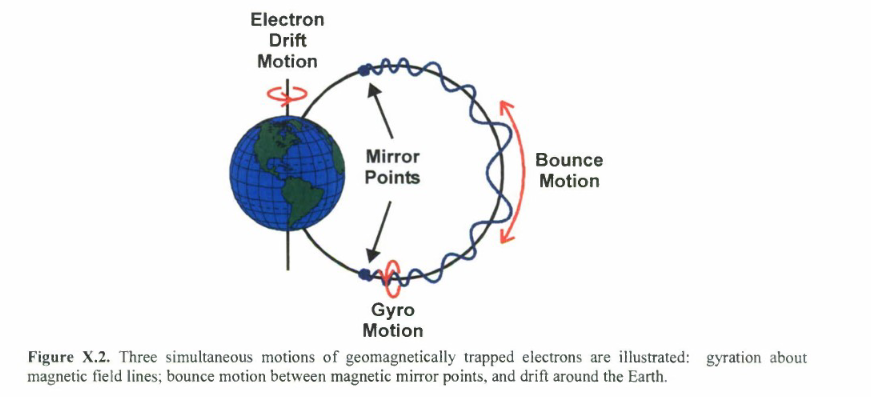
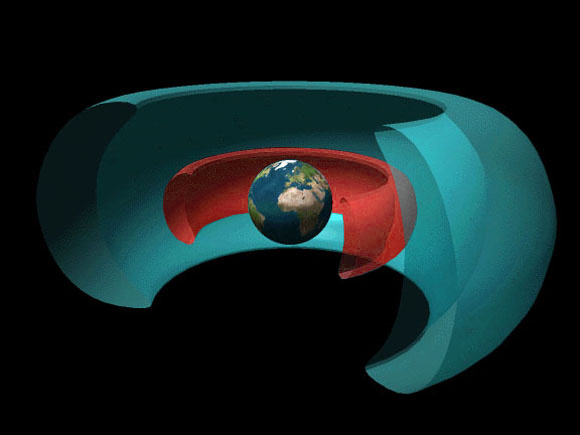
This is similar in a way to the Van Allen Radiation belts that surround Earth, which also contain high-speed charged particles coming from the solar wind. In fact, satellites are purposely not put in orbits that often cross the Van Allen Belts if it can be avoided, as that would lower their lifetime significantly. LEO satellites thus operate mostly below the inner belt.
Impact in Low Earth Orbit
Detonating the device at a low altitude and close to the equator will create an artificial radiation belt that takes out the LEO satellites. This is what happened in the Starfish Prime high-altitude nuclear test in 1962, where a 1.4 Megaton explosion of a fusion device at 400 km altitude took out of service 9 of the 25 satellites orbiting at the time.
The DTRA report includes the following tables, detailing the delayed radiation effect on LEO satellites for various simulated detonations. NOAA is in a 800km polar orbit, TERRA in a 700km polar orbit and ISS is in its 320km x 52° orbit, but contrary to the others its radiation limit is the lethal dose to the crew. For the artificial satellites, it is assumed they fail after receiving twice the total natural radiation they would have received during their normal lifetime:
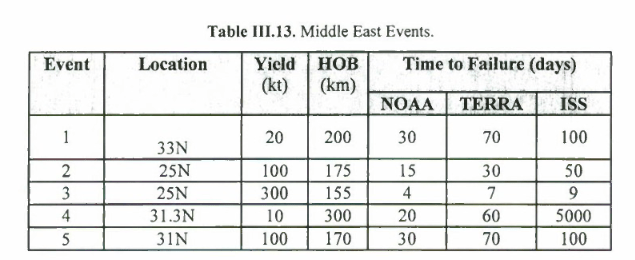
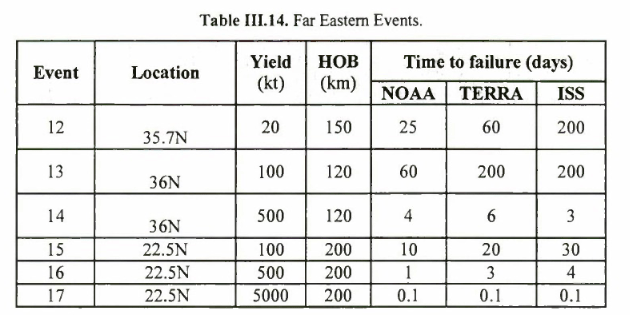
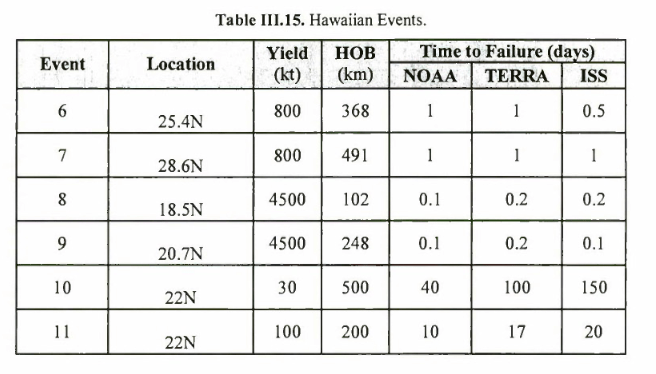
We see that first the effects are not linear with the yield of the weapon: a 10 times more powerful does not always translate in a lifetime reduced by 10 times. Second, there is a strong dependence on the latitude (ie the North-South position) of the burst. This is because depending on it, the electrons are trapped in a different shell of the magnetic field (called L-shells), and so they do not impact the same orbits:
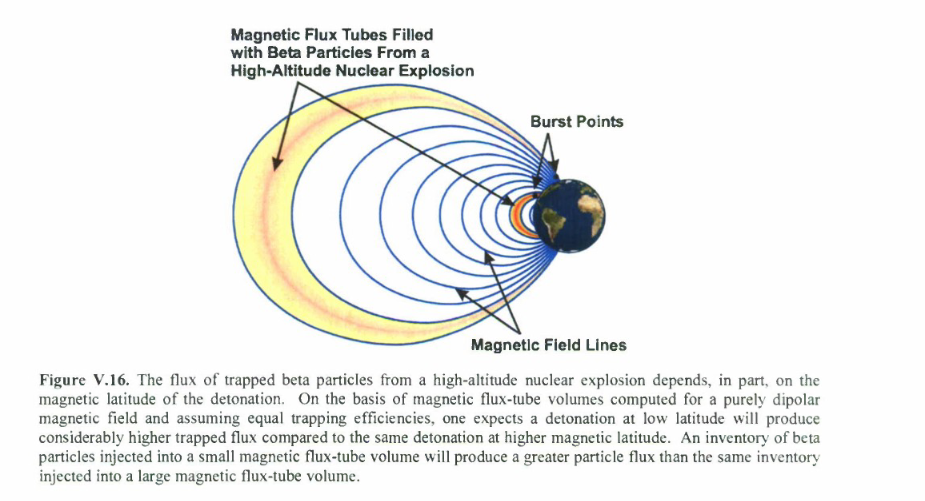
Higher latitudes result in electrons reaching higher orbits, but they also occupy shells with higher volume, spreading the particles further apart and decreasing the impact on satellites.
Overall, we see LEO satellites can be targeted very efficiently with a large explosion at low latitude, such event number 17 which has a 5 Megaton yield detonated at 22.5° North at an altitude of 200km. This event would give the ISS astronauts a lethal radiation dose in about 3 hours. Even 10 times smaller yields in the hundreds of kiloton range, like in events 6, 7 and 16, would give the satellites and astronauts only a handful of days to live.
On a longer timescale, we see from Starfish Prime that although the detonation occurred at 400km altitude and 17°N, 4 months later the maximum radiation intensity is around 1500km altitude, and below 800km the radiation is lower by a thousand times.
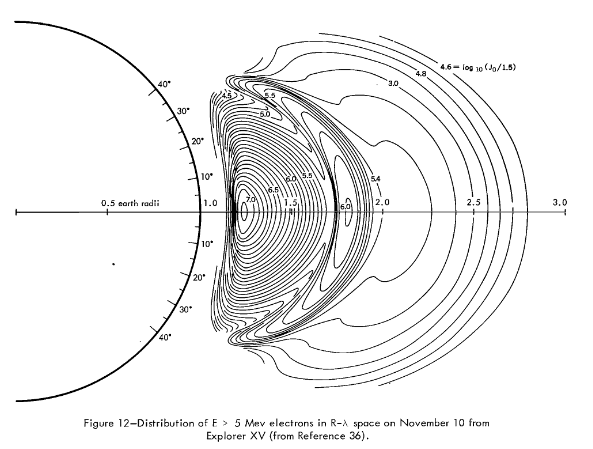
At 400km or lower, the environment becomes safe again quickly after the explosion, as the electrons do not reach that low, except in a small spot due to the South Atlantic magnetic anomaly:
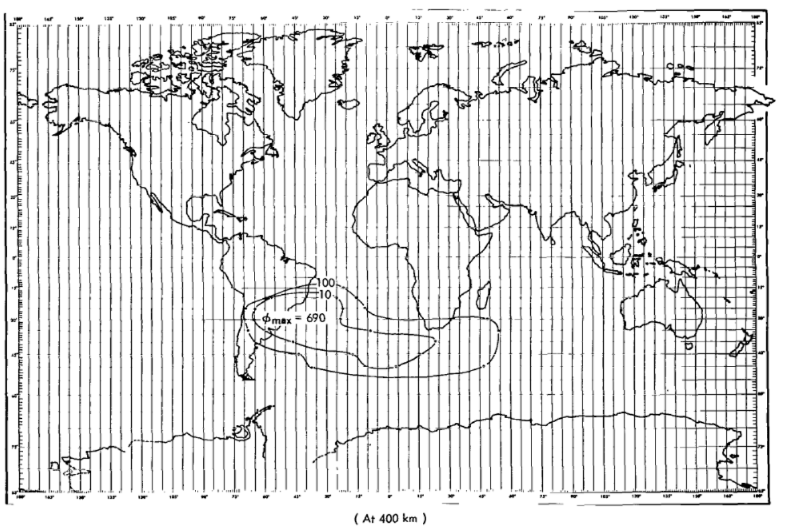
So it seems low-altitude LEO becomes exploitable again quickly after the detonation. If batches of satellites are kept on the ground just in case, and responsive launch is available, an emergency capability could be reestablished. However, is it really worth it when a second detonation could destroy it too?
Hardening the satellites against radiation using thicker shielding the usual is another possible mitigation. However, it is not the road taken by the US Space Development Agency, which is responsible for one of the two American governmental mega-constellations. Instead, its director said they will rely on the fear of collateral damage:
At that point, it’s one of those ‘Black Swan’ events that we’re not going to completely change our architecture to try to address, Tournear said. We know obviously that would have a major impact on our architecture and our capabilities, if something like that went off in space. But it would have a major impact worldwide. It wouldn’t be attack on SDA, it wouldn’t be attack on the Space Force. It wouldn’t be attack on U.S., it would be an attack on the world. So we just would have to address it accordingly.
The reason for this might be that shielding has limits: while it is effective against natural radiation, with a 2.5mm aluminium shield reducing the dose by a thousand times, the electrons released by fission are higher energy and the same shield reduces the dose by less than 10 times. And some components, like solar panels, cannot be easily shielded. The most powerful bursts of the DTRA report can take them to their end-of-life radiation limit.
Notably, while some recent designs like Europa Clipper’s electronics vault rely on heavy shielding, some of the space industry has moved away from “hardware” radiation hardening using tailor-made parts to a more “software” approach where multiple redundant standard parts are used, like SpaceX did for the Dragon. That protects against transient events like memory corruptions that require a subsystem reboot to get rid of, and happen in normal radiation environments. Against the elevated dose (both in total integrated dose and instantaneous flux) of an artificial environment, these architectures might have a different behaviour than what the DTRA studied.
There are more speculative countermeasures, such as emptying the belt using low-frequency radio waves, but relying on them to act fast enough is risky.
Higher Orbits
As explained above, higher orbits can be reached even with a low-altitude detonation, provided it occurs at high latitude, but the effects are much less severe. To reach the GPS orbit or the geostationary orbit, Russia could detonate a weapon over its territory in the North of Siberia or in New Zemble, its historical test site for large yields:
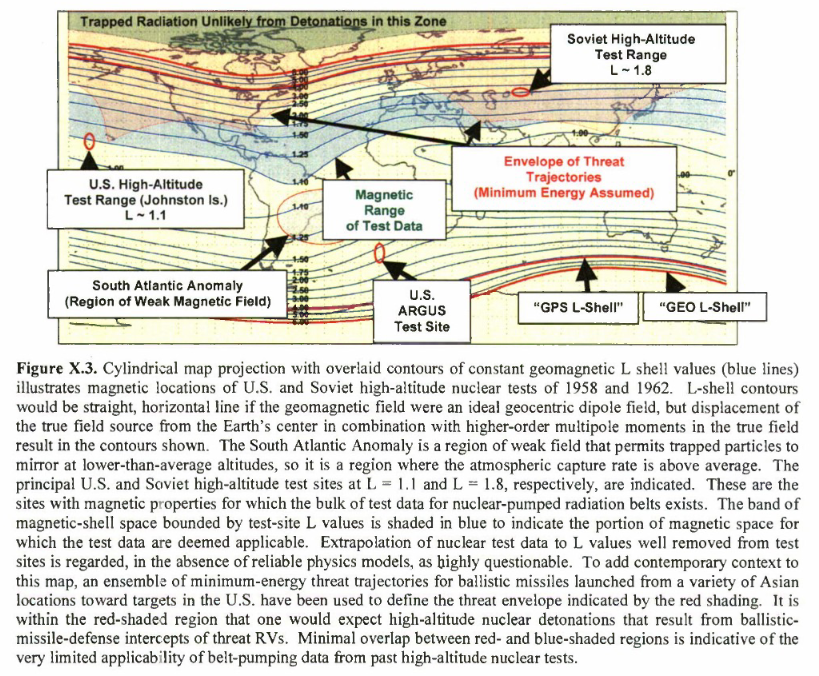
However, such explosions at high latitudes have never been tested, so there are large uncertainties in their effects. And because of the collateral damage, and the fact that it would violate the 1963 Test Ban Treaty which prohibits doing detonating nuclear weapons in space for testing, it is unlikely their ever will. If they behave as predicted, with very large yields they could shave years off the lifetime of GPS satellites, creating gaps in coverage, but not immediately:
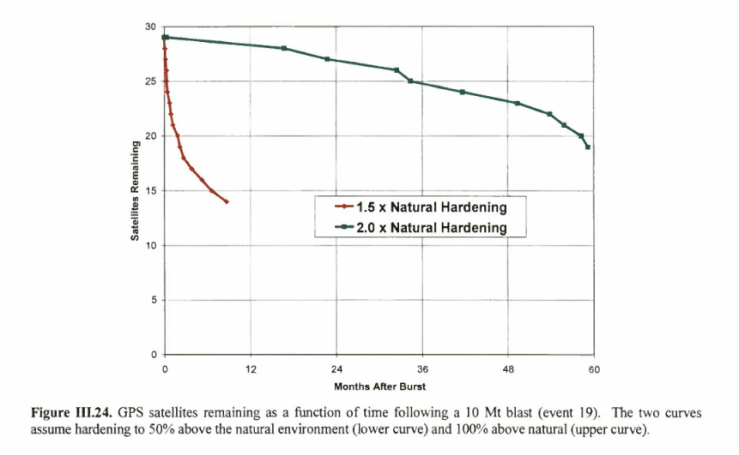
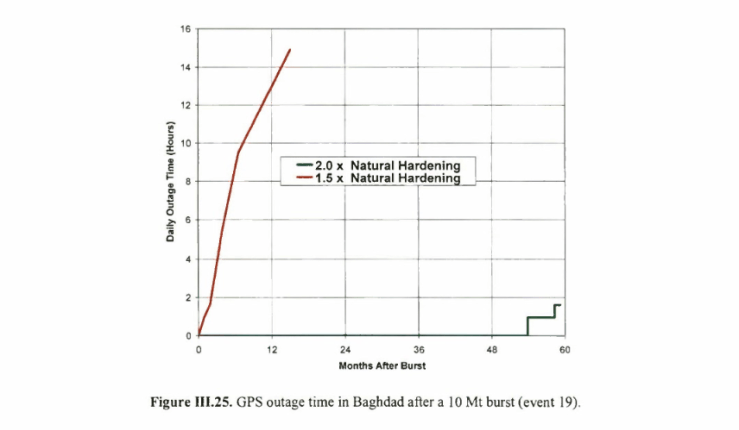
In geostationary orbit, the effects are lower and almost negligible.
Weapon design
Since the electrons are produced by fission fragments and not by the fusion process, here too a fission weapon is much more interesting than a H bomb. An A-bomb with a big tamper around it would minimize the EMP by capturing the gamma rays, while providing material to generate fission fragments by capturing all the neutrons getting out of the core and making them useful, probably resulting in more electrons trapped by the magnetic field.
Conclusion
By detonating a nuclear weapon above the atmosphere at the right latitude, the Russian could create an artificial radiation belt that would take out all low Earth orbit satellites in a few days, and render all but the lowest altitude orbits inhospitable for months. However, they have no need to put the weapon in orbit and thus violate the 1967 outer space treaty to do it, they could instead use a ballistic missile with enough payload. This could even be accessible to countries with basic missile and nuclear technology like Iran and North Korea, and they don’t have much to lose regarding their national space assets. The launch would be detectable and could be confused with a real nuclear strike, making it quite dangerous in the tense scenario where it would likely be used.
The orbital solution, by comparison, would give no warning at all before detonation. Nevertheless, it could also be used as a zero-warning EMP weapon against an area on the ground, which is not so threatening to nuclear forces (and militaries in general) as they are supposed to be EMP-hardened, but would still make everybody nervous and cause tremendous damage on civilian infrastructure. It could also be taken for a ground strike-capable weapon with a deorbit motor and a heat shield. That would break the dual warning afforded by ballistic missile launch, as the small burn of the deorbit motor might not be detectable by satellites, and only ground-based radars would detect the change in trajectory, but later and only if they are pointed in the right direction. So overall, the orbital weapon can be just as destabilizing by reducing the response time the Americans think they can afford.
Regarding the collateral damage caused to third parties on orbit, it is not a downside, but a feature: it signals that a step has been crossed in the escalation ladder and that the perpetrator is willing to destroy its own satellites and those of its partners to gain an advantage by removing enemy constellations. That would level the playing field in a conventional war, and also hamper the US counterforce capability against Russian mobile launchers for instance.


[…] the next article, we will compare these low collateral damage methods to the brute force approach of just detonating […]
LikeLike
[…] The United States has recently revealed it has discovered Russian plans to put in orbit a nuclear device able to threaten US satellites. There are not many details, and American journalists have written articles describing either a nuclear bomb, or a nuclear-powered satellite. Reporting favours the nuclear bomb hypothesis, but Russia is at the leading edge of nuclear power development and has plans to build spacecrafts with a nuclear reactor. This first article proposes to first review these plans, and future issues will expand on how a satellite with a lot of electrical power can be useful against US satellites and especially their military low Earth orbit constellation currently being launched. We will review jamming and then directed energy applications: High Power Microwave, Neutral Particle Beams and lasers. Later, we will compare these methods against a high-altitude nuclear explosion. […]
LikeLike
[…] intensity of the existing Van Allen belts. This is believed to have led to the premature loss of 9 of the 25 satellites in orbit at the time. Seven of those destroyed were American. The blast’s most famous victim was Telstar, the […]
LikeLike
[…] intensity of the existing Van Allen belts. This is believed to have led to the premature loss of 9 of the 25 satellites in orbit at the time. Seven of those destroyed were American. The blast’s most famous victim was Telstar, the […]
LikeLike
[…] intensity of the existing Van Allen belts. This is believed to have led to the premature loss of 9 of the 25 satellites in orbit at the time. Seven of those destroyed were American. The blast’s most famous victim was Telstar, the […]
LikeLike
[…] intensity of the existing Van Allen belts. This is believed to have led to the premature loss of 9 of the 25 satellites in orbit at the time. Seven of those destroyed were American. The blast’s most famous victim was Telstar, the […]
LikeLike
[…] intensity of the existing Van Allen belts. This is believed to have led to the premature loss of 9 of the 25 satellites in orbit at the time. Seven of those destroyed were American. The blast’s most famous victim was Telstar, the […]
LikeLike
[…] intensity of the existing Van Allen belts. This is believed to have led to the premature loss of 9 of the 25 satellites in orbit at the time. Seven of those destroyed were American. The blast’s most famous victim was Telstar, the […]
LikeLike