

Every two years the aviation world convenes for the Paris Air Show, where usually Airbus and Boeing compete for the highest number of planes contracted by airlines. On the sidelines, there is a much smaller gathering about space, attended mostly by French and European institutions and companies.
This year, there were a few interesting displays and announcement.
Military small satellites
First, the French Ministry of Armed Forces had a stand showcasing its small satellite projects:
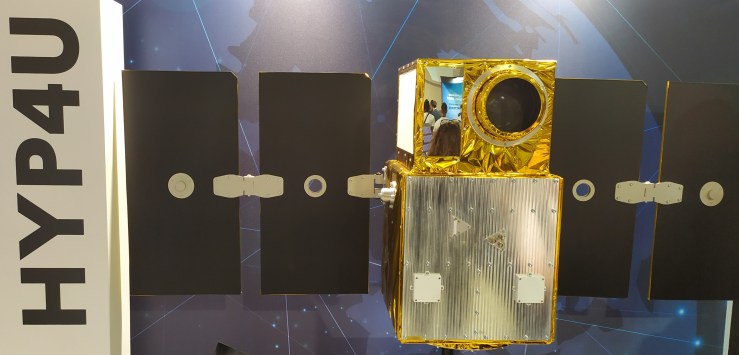
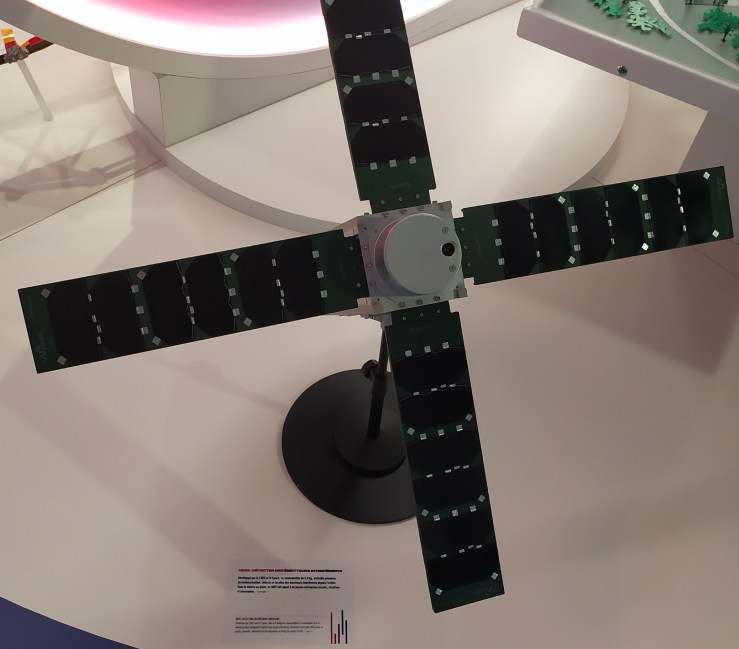
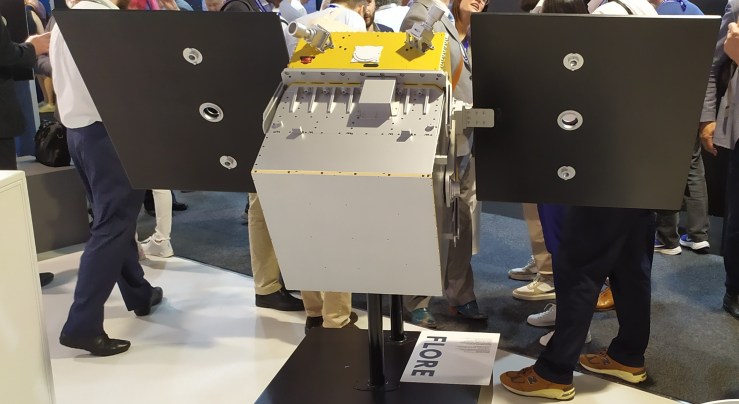
In no particular order, they were:
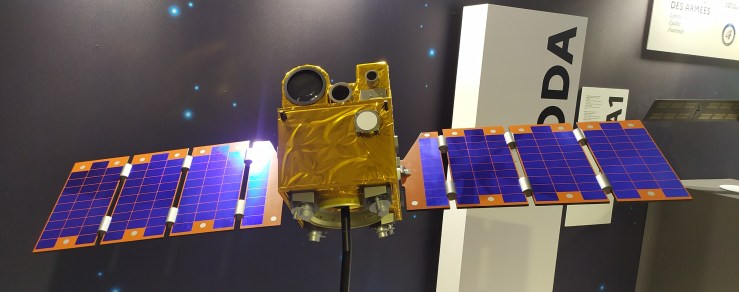
- The YODA geostationary patroller, built by Hemeria. Two are on order.
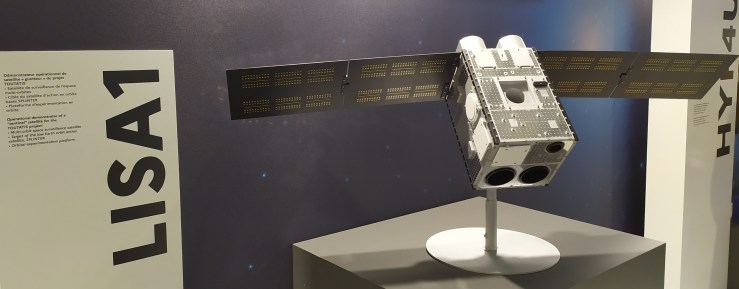
- The LISA1 low Earth orbit patroller, built by U-Space. It will also serve as a target for the Splinter satellite, also built by U-Space, which will carry a laser from MBDA.
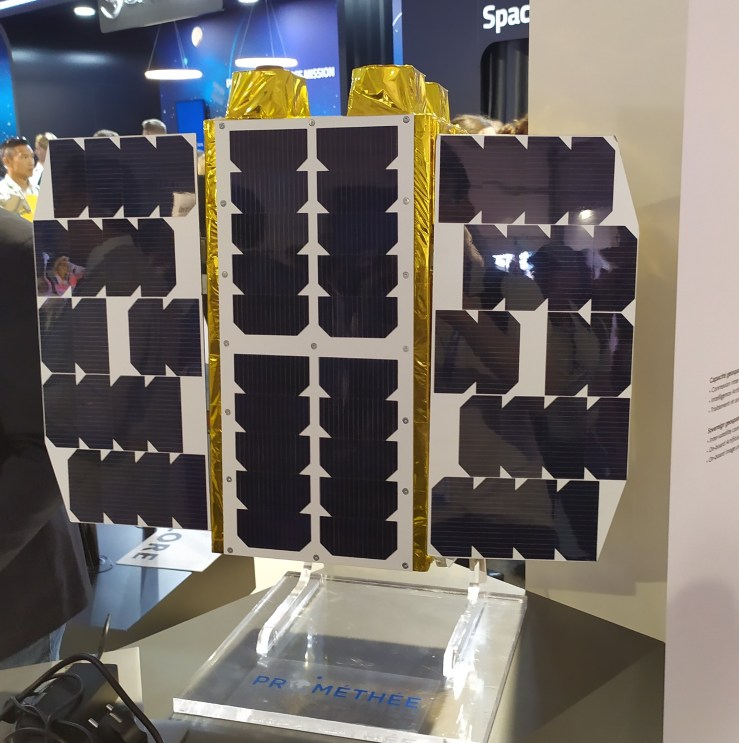
- Promethee’s Protomethee optical observation satellite, a prototype carrying a low-resolution imager, helping the company get familiar with satellite operations before launching its full-scale, higher-resolution constellation. The ministry presented two projects using this satellite, one on using the Kinéis constellation for quicker downlink, and the other on on-board processing of the images.
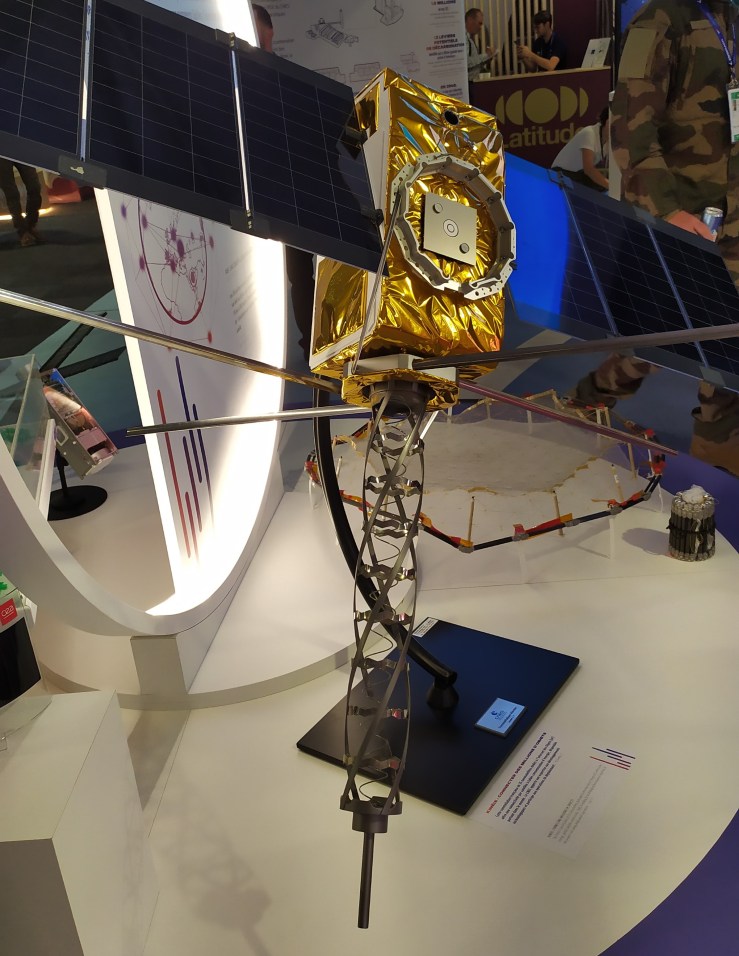
- One of the Kinéis satellites was also on display, they are intended for IoT low-bandwidth communications, and the full constellation of 25 was recently completed. They were built by Hemeria.
- Sophia Engineering’s HYP4U hyperspectral satellite. If all goes well, it will be the first of a constellation, with spin-off company ORUS raising money at the moment.
- The NESS spectrum monitoring cubesat, from U-Space, carrying a receiver built by Syrlinks (now Safran Data Systems). It is already on orbit and will be joined by two identical brothers.
- And finally the larger FLORE signal intelligence satellite, which will use the larger U-Space bus and a payload from UnseenLabs, which also operates its own constellation of BRO ship-tracking satellites.
Very High Altitude strategy
The ministry also used the occasion to unveil its Very High Altitude (VHA, or THA in the original French) strategy. This is France’s answer to the recent developments in the 20-100km altitude region, for instance the famous Chinese balloon that overflew the USA, or the Hypersonic Glide Vehicles complementing traditional reentry vehicles on ballistic missiles.

It hinges on 3 pillars:
- Detection, mostly with radars, either standard Air Surveillance radars like the Ground Master 200 and 400, but which might need some modifications for the role (usually radars filter out slow-moving objects to avoid cluttering the display with cars for instance). The Over-The-Horizon Nostradamus radar will also be upgraded. Its range of several thousand kilometers makes it useful for detecting balloons as well as for early warning of a missile attack. It will be seconded in that role by the Odin’s Eye satellites, built in a European cooperation framework, and apparently a new UHF mobile radar too.
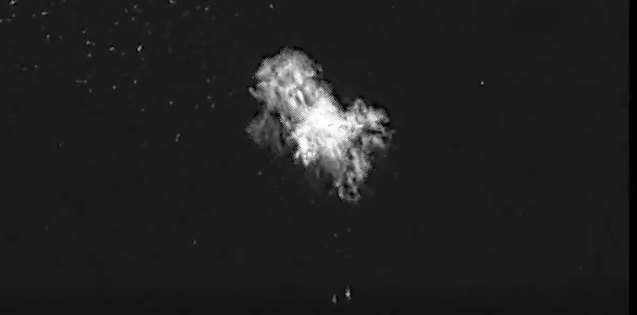
- Interception of hostile objects. Days after the show, the first test interceptions were carried oud by French fighter jets, targeting high-altitude balloons:

Ground-based lasers are also being considered, to dazzle balloon or even satellite optics
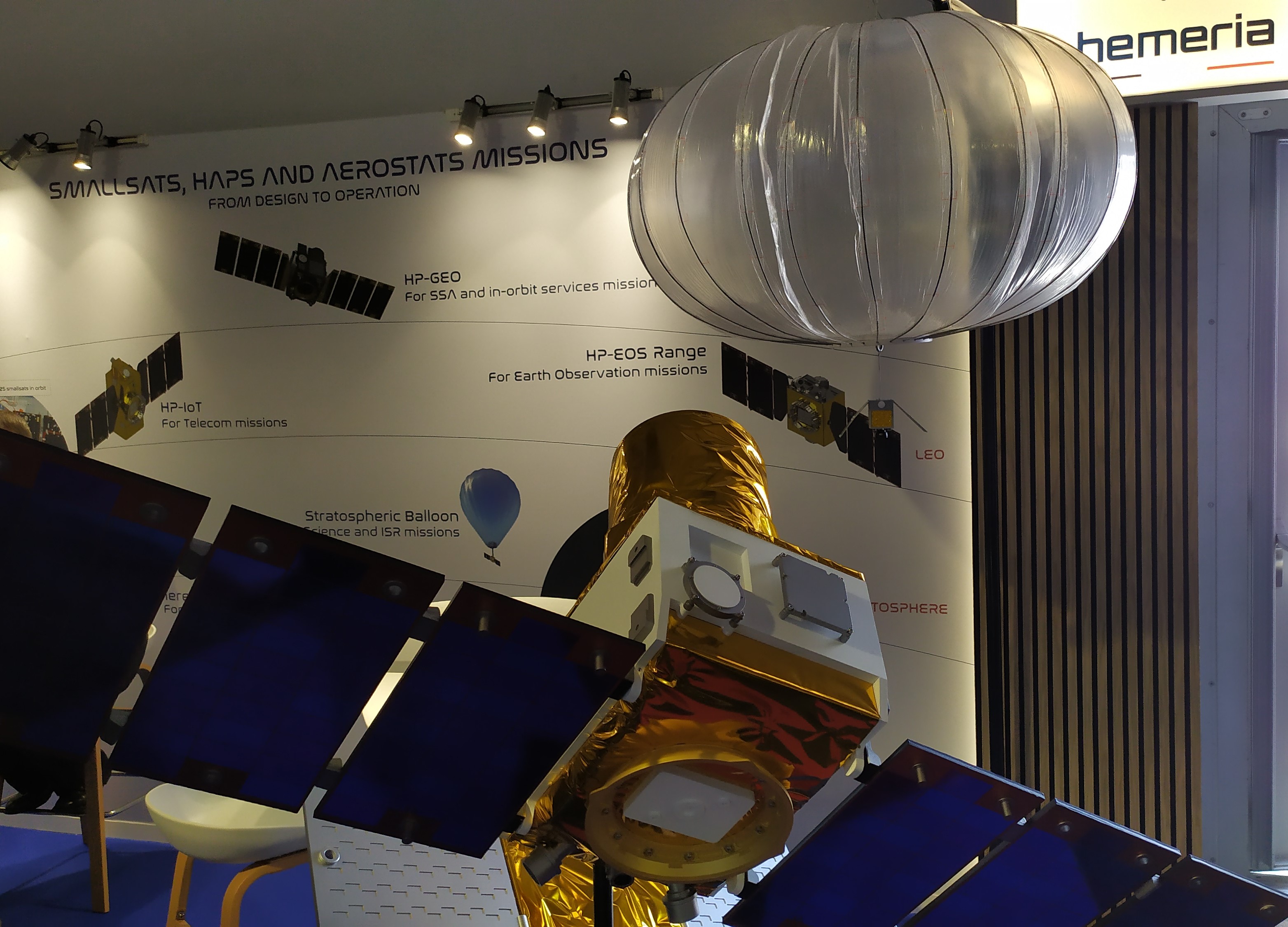
- Finally, operating in VHA. The minister announced funding for the three High-Altitude PseudoSatellites (HAPS) we have been following here for a while: the Stratobus dirigible from Thales, the Zephyr solar plane from Airbus and the BalMan maneuvering balloon from Hemeria.
Launchers
On the launch side of the industry, two companies were presenting products.
HyPrSpace
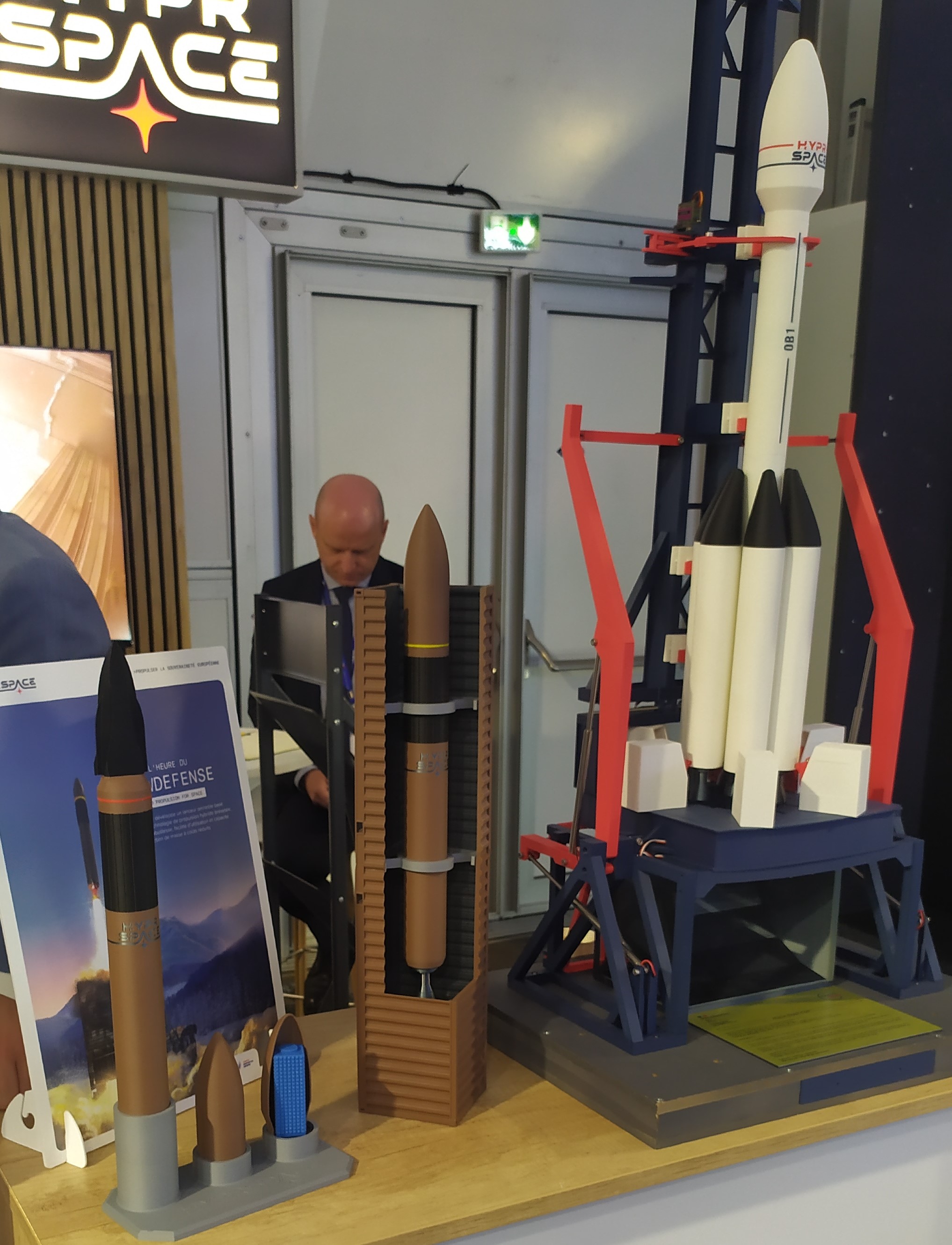
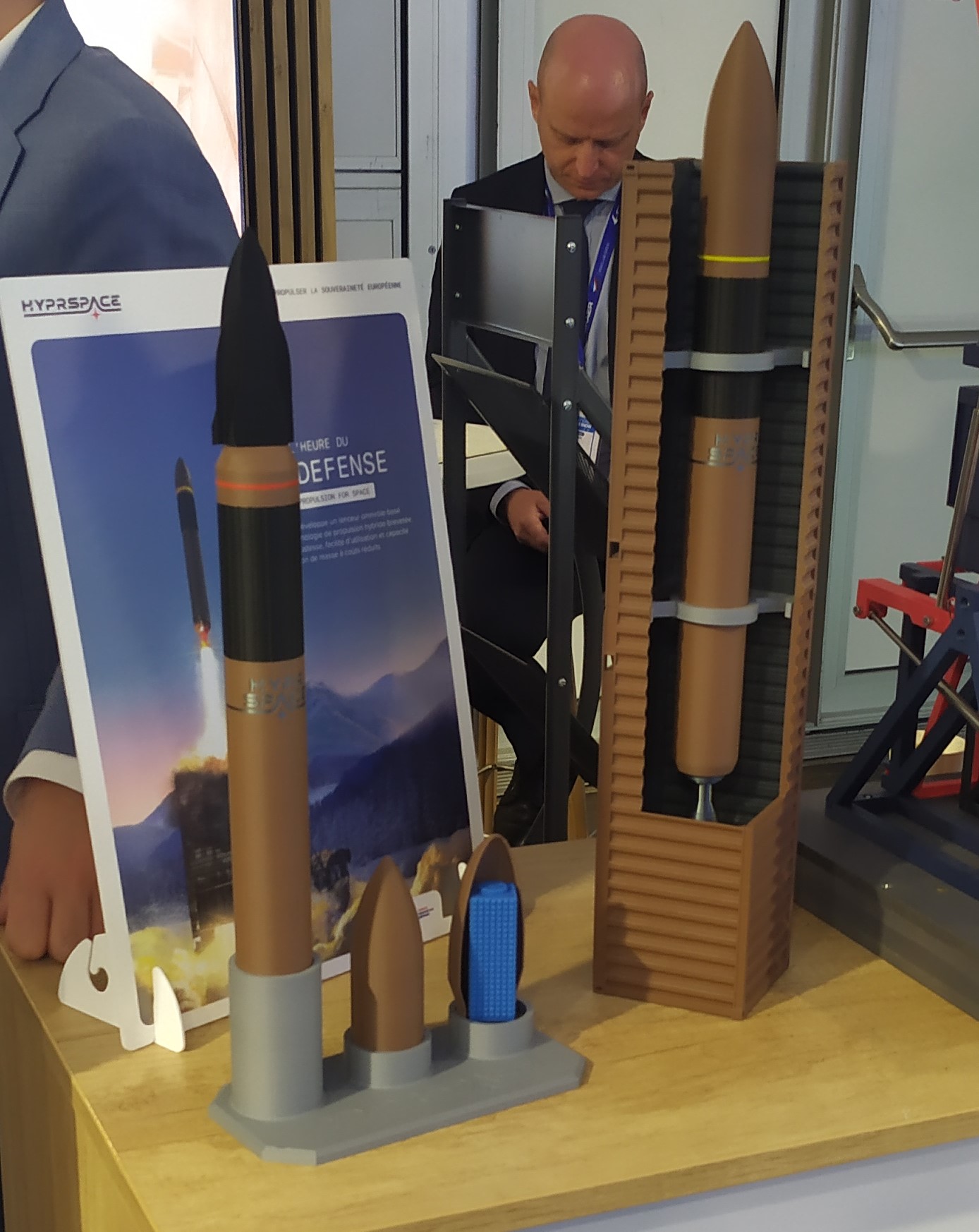
HyprSpace was showing off its Baguette-1 orbital launcher. It uses a hybrid propulsion system, combining liquid oxygen and solid propellant. Compared to solid propulsion, it has higher specific impulse and is throttleable. The launcher uses 7 copies of the same booster as first stage, and 1 as second stage, to carry around 300kg to low Earth orbit. The booster has been tested on the ground, in non-flight-weight configuration, at one the French missile test sites.
Not coincidentally, the same booster was also displayed in French army colours, with a hypersonic glider on top. France is indeed looking for intermediate-range ballistic missiles, with up to 3000km range. A high-performance hybrid motor would be suited for this, although the storage or quick production of liquid oxygen will be an issue.
Arianegroup
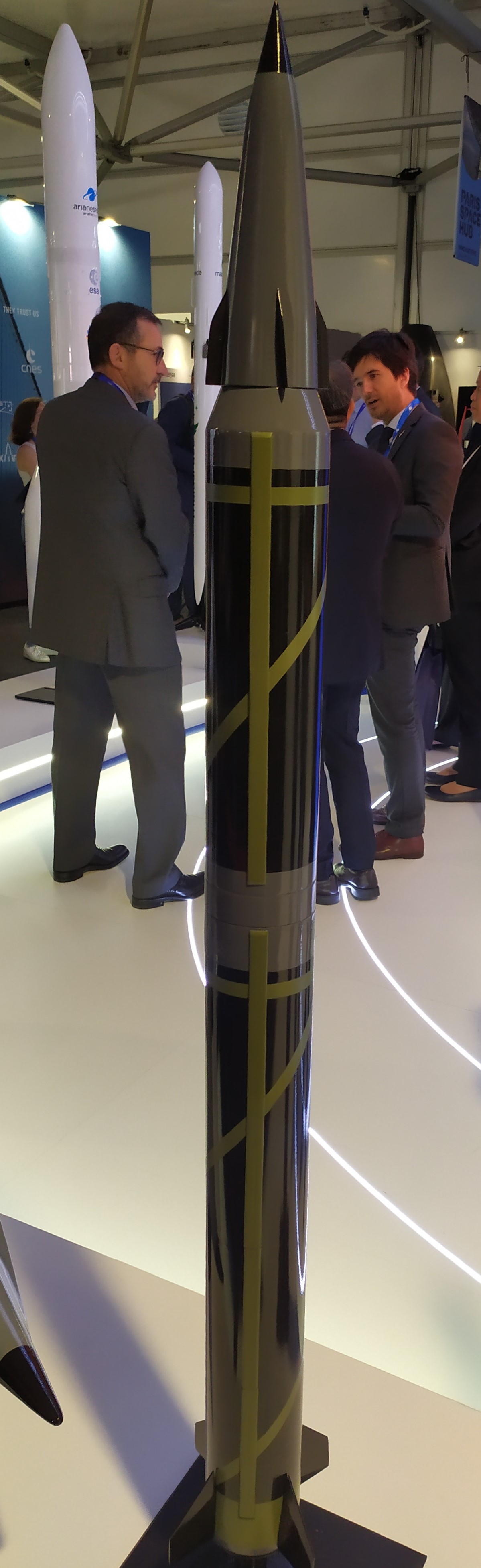
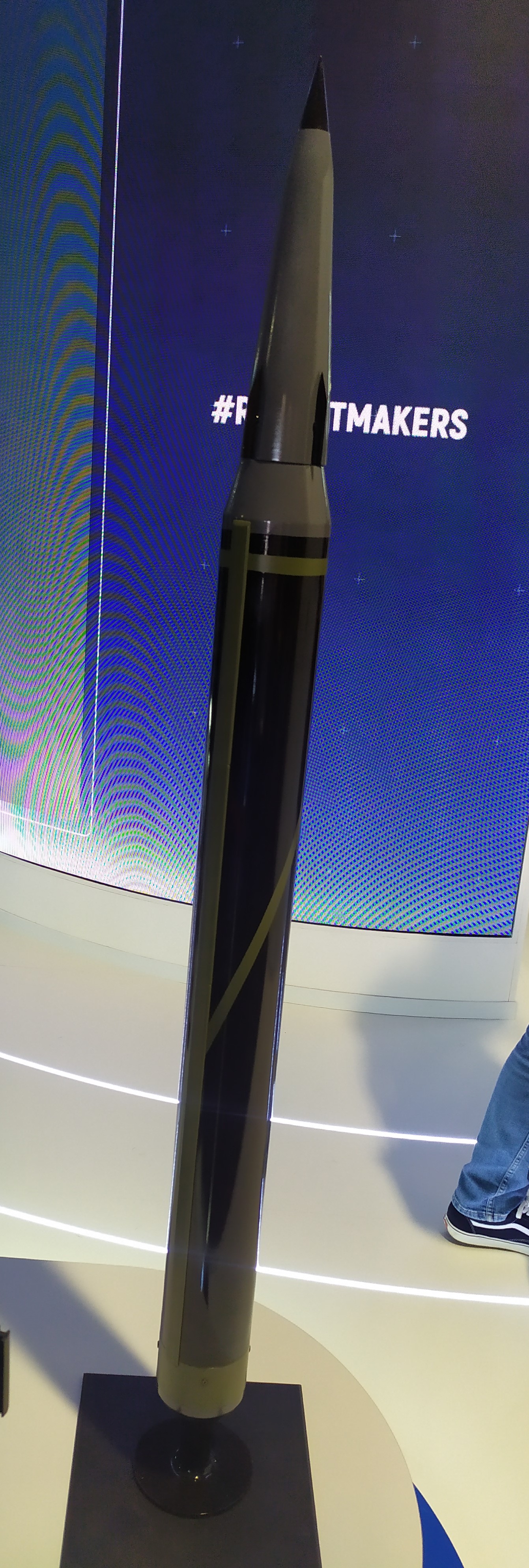
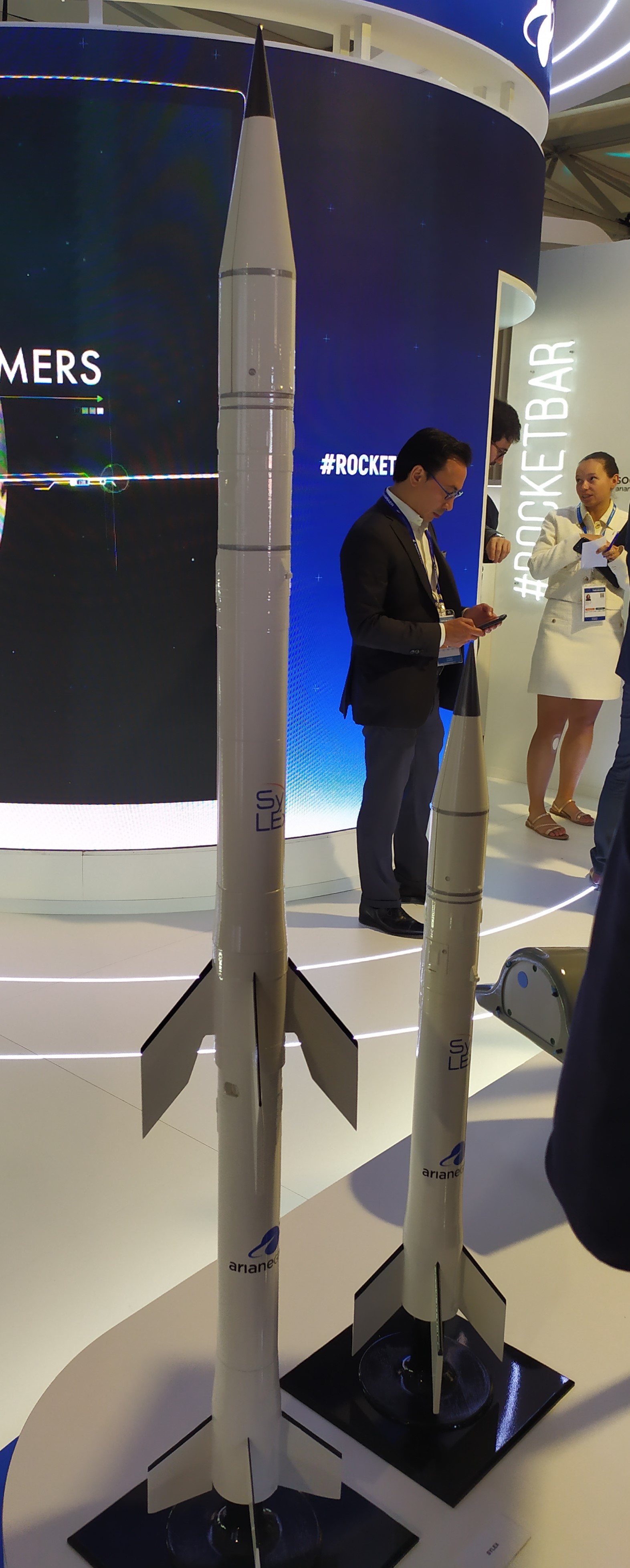
On the neighbouring stand, Arianegroup had Ariane 6 models as expected, and a reusable launcher model from their MaiaSpace subsidiary. But they also had two concepts answering the same military need, and a new sounding rocket.
The missile is called MBT, for Missile Balistique Tactique (Tactical Ballistic Missile, although the range is far from tactical so the T most likely stands for Terrestre, meaning Terrestrial, ie for the Land Forces). It came in one and two stages versions, with the only information provided being that it is “big”. A HGV also sat on top.
On the sounding rocket side, the Arianegroup representatives were a little more talkative. It is called SyLEX, for Système de Lancement Expérimental (Experimental Launch System), and is aimed at replacing the American sounding rockets that France currently uses for its HGV tests. It uses solid propulsion, coming in 1 and 2-stage versions. The motor itself is around 5m tall and loaded with 2 tonnes of propellant. It has no thrust vectoring to save cost. In fact, the whole project has a low-cost philosophy: the only attitude control system is yoyo-despin after engine burnout, the stability in flight being only provided by the fins. Quick pace of development was also paramount, with the whole thing being designed and built in 3 years, the first launch being planned in the remaining months of 2025. Contrary to usual practice for large solid motors, it will not have been test-fired on the ground first.

The project serves first and foremost a military need (launching HGV prototypes like VMAX and testing missile components), but it will be available for commercial experiments, with quite a bit of time spent in microgravity for the 2-stage version. This development will also demonstrate that the company can deliver on time and on schedule for solid motors of intermediate scale.
A sign of the times
Overall, like commercial aviation took second place compared to the military drones and munitions project that populated the halls, the current geopolitical environment had the same effect on the space part of the show, with a heavy emphasis on dual-use and purely defense applications.

 SatelliteObservation.net