

Pseudosatellites, also called HAPS for High-Altitude Pseudo Satellites, are airborne platforms that can fill some missions traditionally dedicated to regular satellites, like communications and observation, with a 24-hours-a-day, 7-days-a-week persistence, at a reasonable cost. The military applications are obvious, with the US Army already integrating high-altitude balloons in its kills chains. France too has been working on the topic for some years, both the state and the industry; and in June 2024 the representatives of three companies gathered at defense show Eurosatory to give an overview of their progress.
The companies were:
- Hemeria, presenting its BALMAN maneuvrable balloon solution
- Thales Alenia Space, presenting its Stratobus dirigible
- Airbus Defense and Space, presenting its Zephyr solar-powered plane
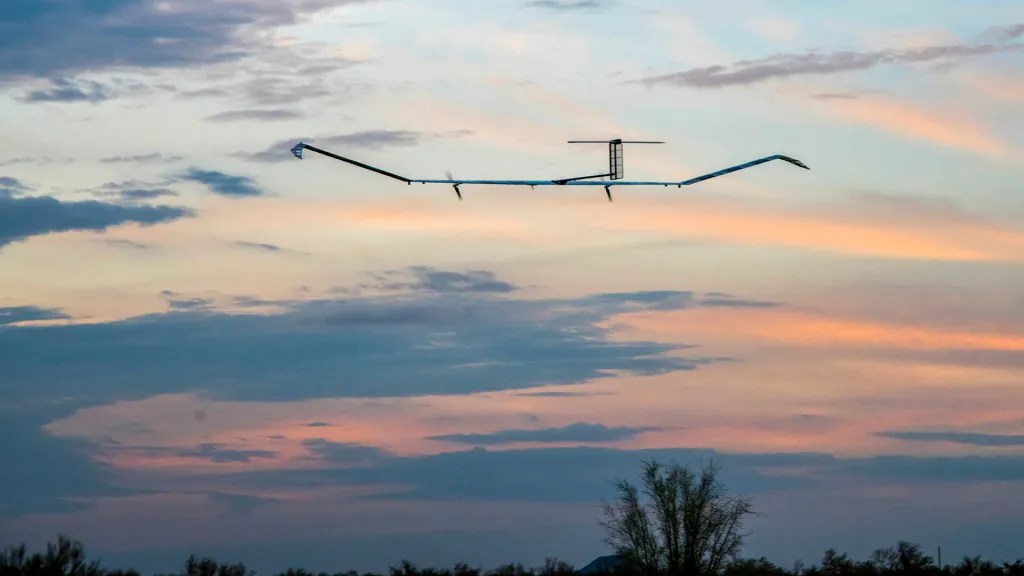
Zephyr
After an introduction of the topic and the speakers by Nicolas Multan, the CEO of Hemeria, Emmanuel Flory, Head of Geospatial Solutions at Airbus Defence and Space, opened the session by saying that Airbus sees HAPS as a natural extension of its business: since the company already designs and operates its own observation satellites like Pleiades Neo, it makes sense for them to complement the service already offered with the capabilities of HAPS. They plan to do so with their own platform, the Zephyr solar plane, and also by using Hemeria’s BALMAN balloon with their own payloads.
Regarding Zephyr, it is a British-built very light airframe, coming in at only 65kg for a 25m wingspan. Its first long duration flight took place in 2018, with 3 weeks spent airborne. Since then, this duration has increased, with a record of 64 continuous days. The plane is almost operational, with its certification scheduled to take place in 2025, the first of its kind for a HAPS. By that point, it should be able to stay aloft for 3 month at low latitudes, with an objective of 6 month persistence to be reached in two years. The payload capacity is currently 5kg, to be increased to 8kg in two years and then 14kg two years later. Airbus has developed its own optical and mesh networking payloads, but is open to external offerings by third parties.
Very recently, Airbus announced it was forming Aalto, a subsidiary dedicated to developing Zephyr and commercializing it. Their main business model it to use it to provide stratospheric 5G, meaning to replace around a hundred 5G towers with a single plane, which would make 5G coverage much more affordable in sparsely populated areas. So far, 100M€ has been invested in Aalto by a consortium of Japanese communications operators. Airbus sees this as a very positive sign, and aims to scale up to hundreds of Zephyr in the air in a few years. This will allow for economies of scale which will make the plane much more affordable for other uses like defense, where they see a market of some tens to a hundred units.
For communications, Aalto would provide HAPS as a service, meaning it would not sell Zephyr itself, but a communication service over an area, and it will be up to them to build, launch and transit some Zephyrs to the target zone to provide the necessary persistence. Once on-zone, customers can get control of the payload. They plan to do this by setting up 3 or 4 “launch sites”, the first one being in Kenya where the generous weather and the high sun intensity thanks to being close to the equator make the site usable 10 months a year. After taking off and reaching its operational altitude above traditional airspace, the plane can get around the globe in less than 10 days, meaning the transits are short compared to the 6 month operational mission. After this duration, the plane lands (not necessarily at the same place where it took off), is refurbished and its batteries are changed, and it is ready to begin the next cycle. Airbus will soon test a Kenya to Europe flight, where some military customers are interested by what it can do over the Mediterranean.
Regarding military applications, Airbus sees a market in Intelligence, Surveillance & Reconnaissance (ISR), which is carried out currently by drones like the Predator or Global Hawk, as well as communications. Signal intelligence is seen as very promising, probably because it is purely passive, not requiring a lot of power and volume like radars, and because radio waves go through clouds, whereas optical imagers can be blocked, and have poor resolution at long distance. Airbus is working on an infrared payload for next year, and a third party is working on a mesh communication payload.
Finally, one advantage of Zephyr is that it is very hard to detect: with its electrical propulsion, its infrared signature is very low, and the lightweight construction and well as the small size and low speed make it very difficult to detect with a radar too. And even if it is detected, getting a lock on it with a missile and having it reach the plane is very hard to do.
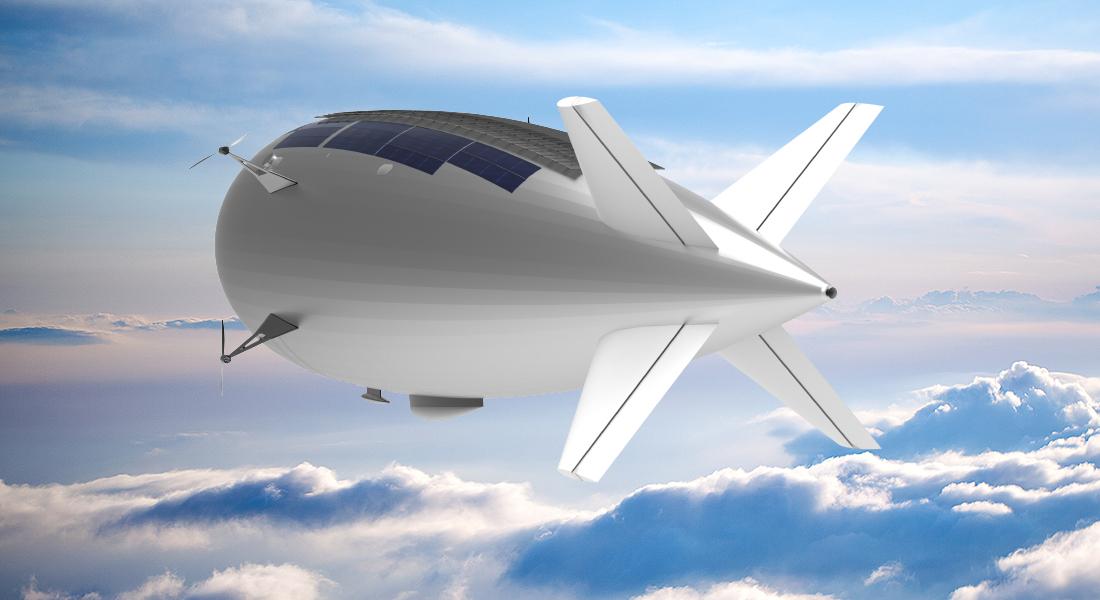
Stratobus
Michel Masselin, commercial director at Thales Alenia Space (TAS) then took the podium to give an overview of their Stratobus solar-powered dirigible. Like Zephyr, its development started a while ago, but the technical solution is very different. Stratobus is filled with Helium to be lighter than air, and that also gives it its rigidity: the envelope has no internal structure. In its full version, it will be 140m long, with 16000 m² of solar cells providing power to the engines for station-keeping and also delivering up to 5kW to a sizeable payload, which can weigh 250 kg. This very large capacity, along with the large space available at the bottom of the platform and the fact that payload-induced drag is less critical than on a plane will allow Stratobus to carry optical and radio payloads like Zephyr, but also radars, and even combinations of payloads. It could also carry antenna farms for signal and communication intelligence. The lack of vibrations compared to standard aeronautical environments is also helpful for sensitive payloads. In operations, Stratobus would take off from a dedicated site, ascend and then stay at high altitude for one year, then land to have its helium refilled and replace some wear and tear parts. Also contrary to Zephyr, TAS envisions a classical business model, where customers (mainly defense ones) buy a platform for themselves.
However, the company will not go directly to the full-size Stratobus, which should only become a reality around 2030. It will start by launching a smaller demonstrator, “only” 60 meters long, whose construction is underway. The first flight should occur by the end of 2025 from the Canary Islands, and it will test out LIDAR mapping, as well as communication intelligence missions, with funding coming from the European Defense Fund and the French Defense Procurement Directorate DGA.
Like his Airbus counterpart, Mr Masselin underlined that although the concept of HAPS sounds simple, in reality a lot of parts and systems have to be developed specifically for this application and that is why the programs take time.

BALMAN
Finally, Alexandre Hulin, HAPS program manager at Hemeria, presented the BALMAN MANeuvrable BAlloon. The project was started in 2021, with the support of DGA and of CNES, the French Space Agency which also has a long expertise in stratospheric balloons. It will have a diameter of 20m and an envelope height of 15m, with a 12 to 25kg payload hanging below the balloon, along with some solar panels to provide power. It will operate between 16 and 25km altitude, where the winds are stable, turbulence is low, and where wind changes direction between 16km and 22km. That allows the balloon to choose its direction by just playing with its altitude, filling or emptying air ballasts to make itself more or less buoyant. This way, it can stay within a box 100km wide, providing persistence, although choosing the right maneuvers to do it can be quite complex. Since they are not very expensive, a fleet of balloons can be launched to ensure one is always on site.
A first balloon envelope test is planned from the French Guyana Space Center in 2024, and a full test with maneuvers in 2025.
One big advantage of BALMAN compared to Zephyr or Stratobus is that it is much simpler to launch. It can take of from almost anywhere, and because it is naturally buoyant will reach its 20km operating altitude in less than four hours. It is also easily foldable and transportable. In fact, it is so flexible Hemeria is thinking about naval applications, where a frigate could carry one or more balloons, and launch them from its helicopter deck. Then, they could provide communication or intelligence services over a wide area (be it an ocean or a coastline) and use their maneuvers to keep up with the fleet’s movements.
Hemeria is thinking about both a traditional business model like TAS and a service offering like Airbus. For military applications, the balloons could carry high-resolution imagers with 15cm resolution like Zephyr, or communication payloads. Mr Hulin stressed that is is important to build a dedicated payload ecosystem with many actors, since the thermal environment (+30°C in the sun, -100°C in shadow) make using off-the-shelf systems a challenge.
Conclusion
The three projects are getting very close to operational status, with 2025 set to be exciting with the certification of Zephyr and its Mediterranean demonstration tour, the first flight of the Stratobus demonstrator and the first maneuvers of BALMAN. Interestingly, the three companies are both competitors but also partners: Hemeria builds the envelope of Stratobus, and Airbus provides a payload for BALMAN. Hopefully, the civilian market combined with the military applications are large enough to keep the three solutions, each with their pros and cons, aloft.

 SatelliteObservation.net
[…] in VHA. The minister announced funding for the three High-Altitude PseudoSatellites (HAPS) we have been following here for a while: the Stratobus dirigible from Thales, the Zephyr solar plane from Airbus and the BalMan […]
LikeLike