

June and July 2023 were packed with conferences and announcements by the French New Space sector. The traditional Paris Air Show returned after four years of absence due to COVID, and was preceded by the Paris Air Forum, a day of talks and roundtables by aerospace executives. A few days later, the second edition of the French New Space conference took place, still in Paris (France is a very centralized country after all).
With all this activity, it’s the right time to take stock of what is going on. This tour will necessarily not be complete, since there are a lot of companies in the sector, but will focus on recent announcement and promising developments, especially relating to Earth observation. Since there is a lot to say, it will be spread into several articles.

For this first article, let’s start with Hemeria, a builder of small satellites. Hemeria was presenting at the Paris Air Show with a to-scale mock-up of YODA, which is a patroller satellite on order by the French Ministry of Armed Forces to have eyes on orbit in geostationary orbit (GEO):
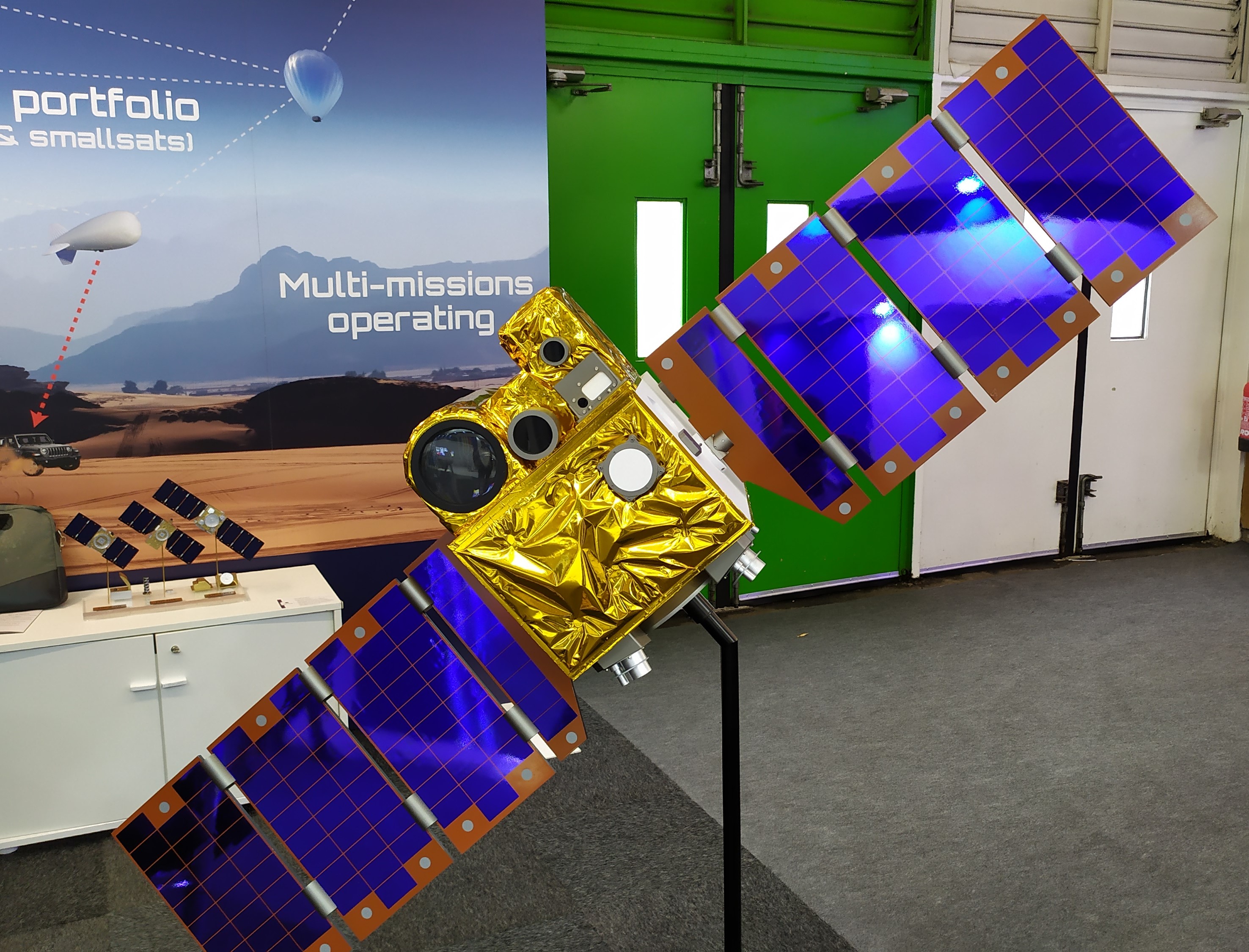
YODA means eYes on Orbit for Demonstration of Agility (yes it sounds as convoluted in the original French), and two copies will be launched in mid-2025 as rideshares to GEO . There, it will protect high-value assets like the Syracuse military communication satellites. French Space Command is also thinking of putting such satellites in low earth orbit, where it has observation satellites to protect. By 2030, a larger, laser-armed patroller called EGIDE will be added.
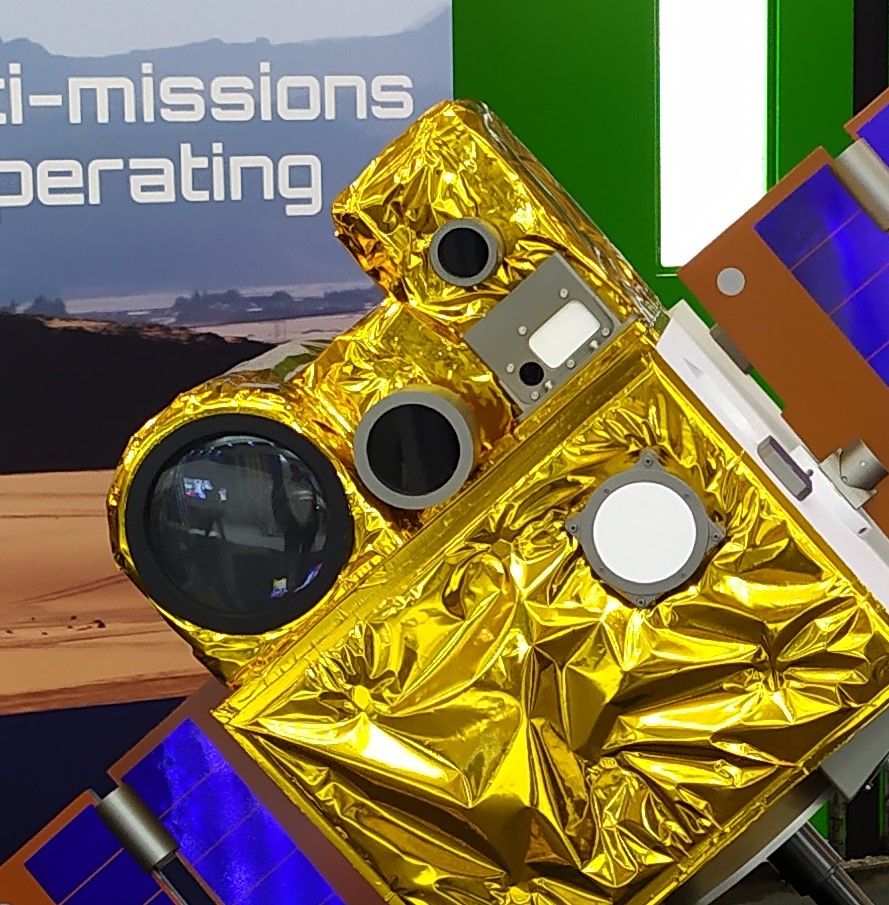
Hemeria makes the bus, and French space agency CNES delivers the payload as government-furnished equipment. Due to the sensitive nature of the satellite, the payload on the mock-up was probably not fully representative of the real one, but it is still interesting to analyze it and speculate. It has a large optic that is likely dedicated to high-resolution imaging for identification and characterization. It also has smaller optics, likely for wide-area search. What is notably absent is a pair of identical optics separated by a wide baseline to do passive stereo ranging.

The opposite side of the optics deck has a wide array of antennas, so it is probably pointing towards Earth for constant communications. That would mean the satellite would operate below the geostationary belt, with the optics pointed up toward it. It makes a lot of sense, as that gives also a same time a view of the GEO graveyard orbit, where there are also interesting objects. Operating above the belt makes surveying it and the graveyard at the same time more complicated, requiring more distance to the objects or to have to point in two different directions.
Interestingly, there is a patch antenna on the optics side, which will consequently point at the satellites to survey. It could be just a backup antenna in case the similar one on the other side fails.

The bus has large solar panels (manufactured by Hemeria itself), and uses 4 electric thrusters to maneuver easily in the belt. Overall, including the payload, the satellite weighs 70kg.
YODA has enabled Hemeria to develop an offering, called HP-GEO, of a dual-use GEO platform, which can be used to bring frequencies in active use at an orbital slot, to provide a small communications capability, including as space data relay, or to provide logistics services as a space tug. Hemeria complements this by two models for Low Earth Orbit (LEO): one dedicated to communications, called HP-IoT, and one for Earth observation called HP-EOS. All these models share a lot of common parts and software.
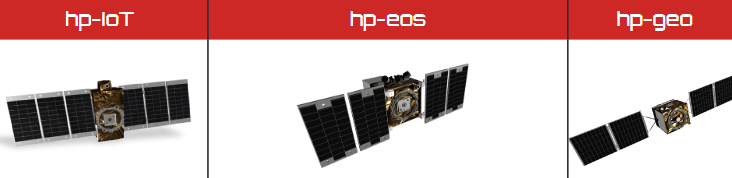
The company has had a lot of success with them, since Kinéis, a spin-off of CNES selling low bandwidth connectivity for Internet of Things applications, has a constellation of 25 HP-IoT on order. The French ministry of economy has also selected one HP-IoT for the ASTROID technology demonstration mission. On the HP-EOS side, the startup Promethee recently announced it has selected Hemeria to build its constellation of 20 optical satellites (more on this in this article). In total, that’s enough business for a few years of production.
Satellites are not the only activity of Hemeria. It also does high-altitude balloons, either as a subcontractor building structures and envelopes for the Stratobus dirigible of Thales Alenia Space, or running its own Balman maneuvrable balloon project for CNES. Thus, it has a very strong position as not only a successful smallsat provider, but also in the pseudosatellites sector, where light, radiation-tolerant, long-lasting solutions are also necessary.

 SatelliteObservation.net
[…] June and July 2023 were packed with conferences and announcements by the French New Space sector. This warrants a tour of what’s happening in the sector. Let’s start with Hemeria, a builder of small satellites — Read on satelliteobservation.net/2023/07/11/tour-of-french-new-space-2023-yoda-hemeria/ […]
LikeLike
[…] first article in this series looked at Hemeria, a very successful builder of small satellites. Today, we look one […]
LikeLike
[…] The YODA geostationary patroller, built by Hemeria. Two are on order. […]
LikeLike