

The first article in this series looked at Hemeria, a very successful builder of small satellites. Today, we look at one of its main customers.
Promethee is a newcomer in Earth observation. It was founded in 2020, with the goal to be a trusted operator able to deliver high-revisit optical imagery for sovereign applications. This means it positions itself towards French institutional users first and foremost, especially the armed forces. As we will cover in a future article, the Ministry of Armed Forces has decided to rely on carefully selected commercial operators for dual-use services. The war in Ukraine has underlined the need for high-frequency, low-latency imaging, and this niche is currently not covered by any European provider.
The Japetus constellation
The first satellite, Protomethee-1, will launch in October 2023 and will provide 1.5m imagery in 7 spectral bands. The next step it the Japetus constellation, which has been contracted to Hemeria for the bus, to Safran for the imager and to CS and CapGemini for the ground segment. That’s a purely French team, in keeping with the trusted operator approach.
The Japetus satellites are very interesting. They use a evolution of the Safran SEEING high-performance imager for cubesats, which was covered in 2018 on this site. The SEEING 230, with its 25cm aperture, will bring a 0.8m resolution in 32 bands.
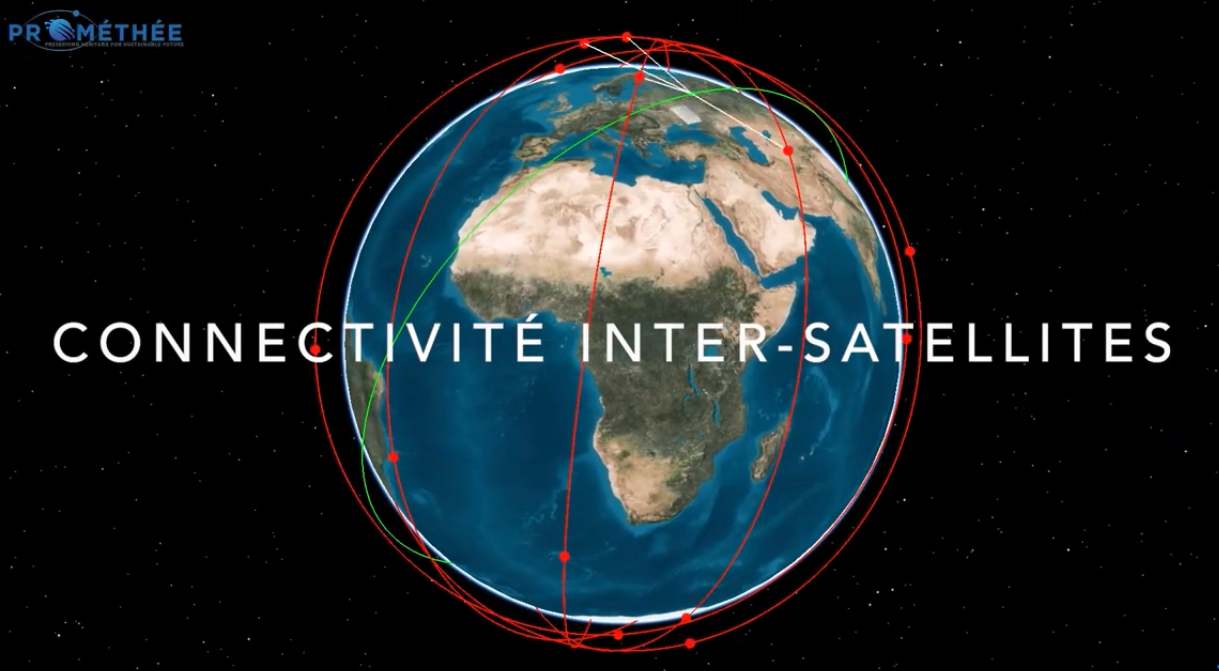
The satellites will use the Kinéis constellation as inter-satellite links. The links are low bandwidth so they cannot carry images, but they will carry tasking orders. Furthermore, thanks to the computing and algorithm embedded in the satellite itself, they will be able to analyse the image and report interesting features through the link. For instance, it can report if an image was too cloudy, or it can even report detection of objects like ships in the image. The embedded compute platform will not have the power of the GPU-accelerated datacenters that companies like Preligens use for AI object detection, but still for the easier problems like maritime surveillance where the background clutter is not too strong, it might just be enough. The idea is to bring down the age of information to near real-time, meaning that the data will be in the hands of the end user 15 minutes after the picture has been taken.
Regarding the constellation as a whole, it will be optimized for high revisit around Europe. From the marketing videos, it means a few satellites on sun-synchronous orbits, and the rest of them on a ~50° inclination, giving a very high revisit over Russia:
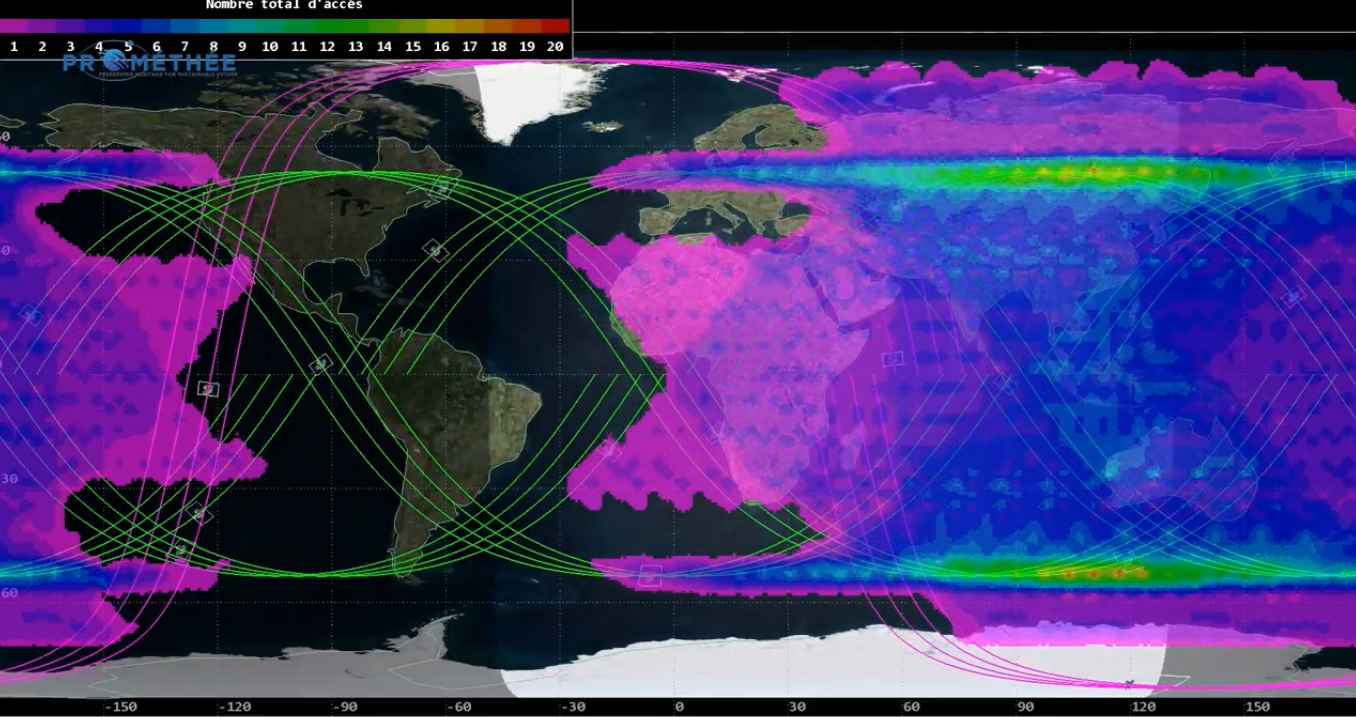
Focusing on interesting inclinations is what other small satellite observation constellations like BlackSky do too, as sun-synchronous orbits are useful for change detection on a scale of a day or more, but for intra-day change detection it has no benefits.
Partnerships
Promethee has a strategy of building partnerships with other actors, as it realized it does not have the expertise for all the imagery applications, and does not have the resources nor the time to become an expert at everything. For instance it works with Hytech Imaging on using satellite imagery to monitor the sea floor near harbours, and with warship builder Naval Group on how to integrate real-time satellite imagery in a naval task force, especially for positive identification of far away contacts.
In addition, the company has been granted the status of Copernicus Contributing Mission, meaning that the EU emergency services will be able to call on Japetus imagery to adress crisis situations, with a budget for that provided by the EU.
Conclusion
Promethee fills most of the role outlined in The case for a French military constellation: a high-revisit, low-latency system for tactical use, at a reasonable price. A further step could be to integrate into the european IRIS² constellation to have proliferated, secure and high-capacity intersatellite links able to carry images, but the current lack of an ISL standard for IRIS² is a problem for that. Also, wide-area and all-weather capabilities could be interesting, with radar satellites for instance, but that plays less well to the strengths of the French industrial base, and the commercial market for SAR is smaller than for optical.

 SatelliteObservation.net
[…] it has selected Hemeria to build its constellation of 20 optical satellites (more on this in this article). In total, that’s enough business for a few years of […]
LikeLike
[…] imager, helping the company get familiar with satellite operations before launching its full-scale, higher-resolution constellation. The ministry presented two projects using this satellite, one on using the Kinéis constellation […]
LikeLike